


Focus corrects itself.
Temperature, time, degrading HFR, flip: focus is corrected during the night, between two frames.
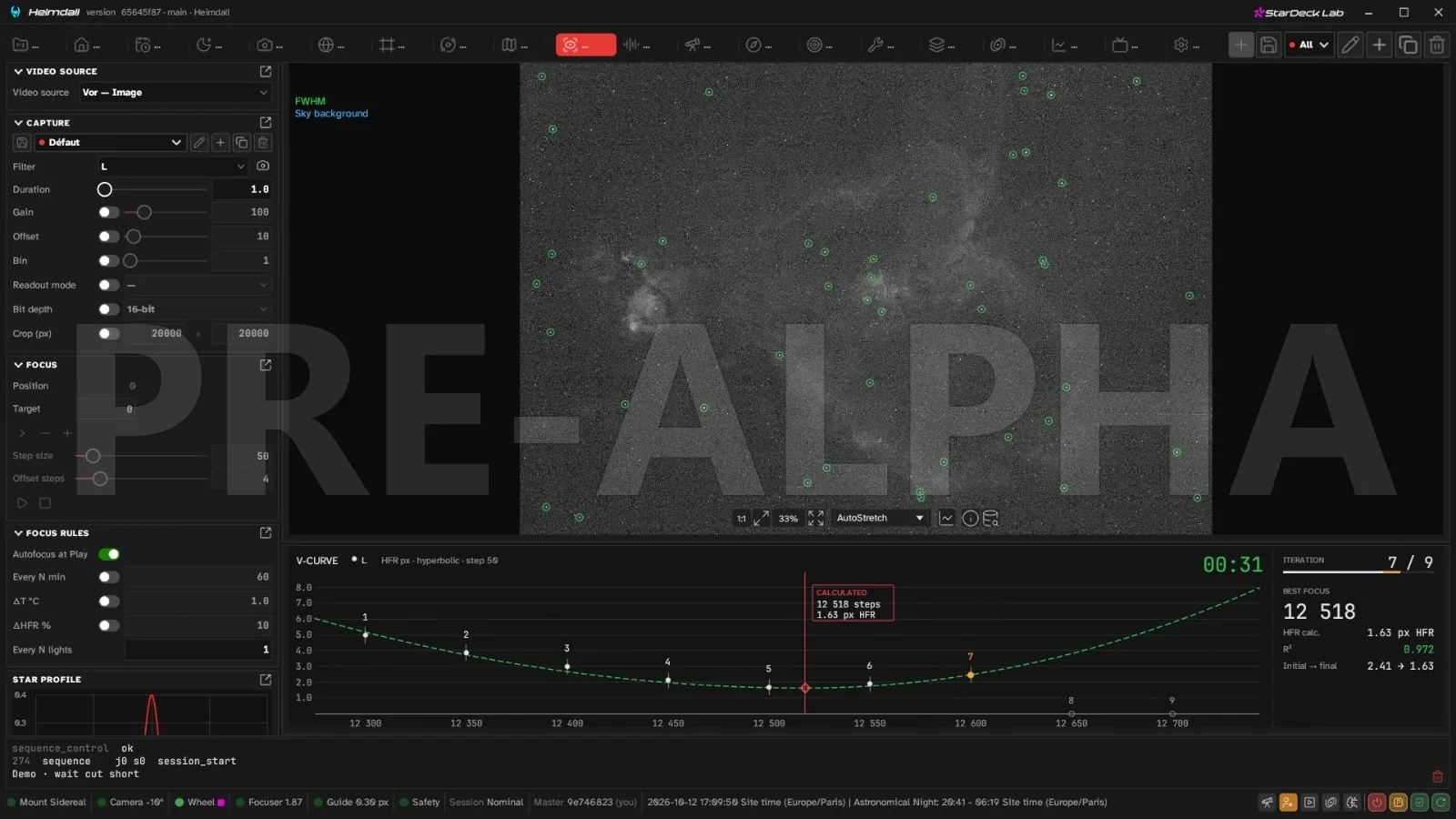
V-curve and best position
Workshop · 10 / 17
autofocus and its hyperbolic V-curve
An autofocus routine that measures how sharp your stars are, fits a hyperbola to the V-curve and puts the focuser at the sharpest point.
Focus is the focusing workshop. It runs autofocus on demand, triggers it by itself during the night when sharpness degrades, and shows live the curve that justifies the position it picked.
Temperature, time, degrading HFR, flip: focus is corrected during the night, between two frames.
The V-curve with its hyperbola, best point and iterations shows what autofocus measured and why it picks that position.
15% validation, exposure cap, starless sky, focuser dropout: the routine goes back to the last good position instead of chaining blurry images.
Every measurement and every result is logged, with the trigger cause and the outcome.
Focus drifts: temperature changes, the tube contracts, stars bloat. Refocusing by hand in the middle of the night costs frames and attention.
Focus automates the gesture. It takes a reference exposure, sweeps the focuser on either side of the point, measures the HFR (star sharpness) at each position, fits a hyperbola to the measurements and aims for its minimum. A validation exposure confirms the result; if it is worse than the reference, the routine fails and the focuser goes back to its last good position.
Manual focusing or a plain fixed-step sweep burns exposures for little information. Here the routine relies on a hyperbolic fit, the physical shape of the sharpness curve, and knows when not to trust its measurement.
A standalone autofocus module is launched by hand. Focus also triggers itself, by rules you choose, and fits into the night's plan.
The measurement rests on the HFR of many stars rather than one: it rejects saturation, trails and elongated objects.
No ads. The project runs on support from the people who use it.